
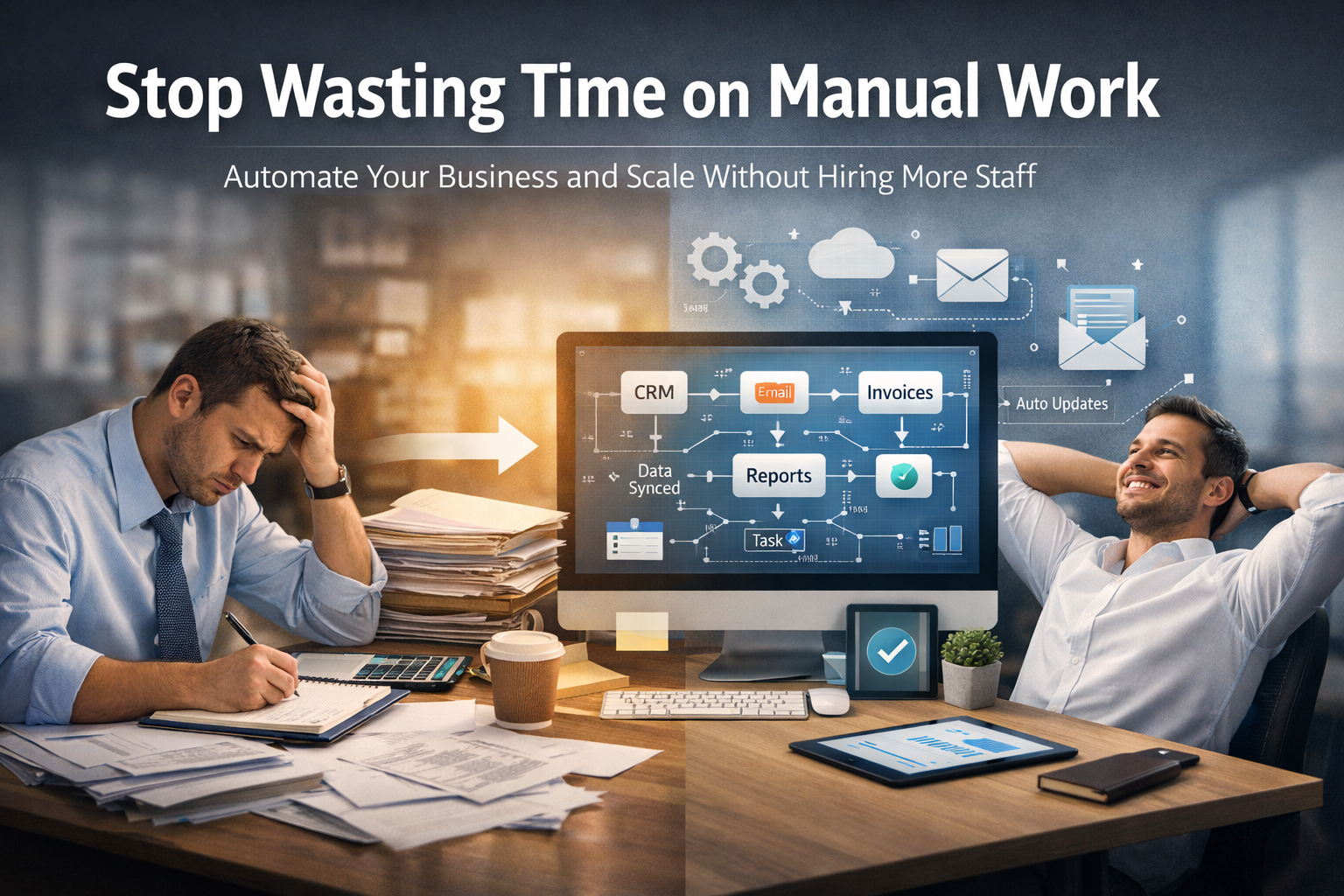
Stop Wasting Time on Manual Work
How SMEs Can Automate Operations and Scale Without Hiring More Staff
Small and medium-sized enterprises (SMEs) are under constant pressure to grow revenue, improve efficiency, and control costs. Yet many businesses still rely on repetitive manual tasks to run daily operations. From copying data between systems to manually following up on leads, these processes quietly drain time, energy, and profit.
If your team is spending hours each week on tasks that software could handle automatically, you are not just losing time — you are limiting your company’s scalability.
This is where business automation changes everything.
What Is Manual Work Really Costing Your Business?
Manual processes may feel manageable at first. However, as your company grows, inefficiencies compound.
Common examples include:
-
Manually entering leads into a CRM
-
Copying customer data between accounting and sales systems
-
Sending follow-up emails one by one
-
Generating recurring reports in spreadsheets
-
Creating invoices manually
-
Updating project boards manually
Each of these tasks consumes valuable staff hours. More importantly, manual processes introduce:
-
Human error
-
Delays in communication
-
Missed opportunities
-
Inconsistent customer experiences
For SMEs, this creates operational friction — and friction slows growth.
Why Automation Is a Strategic Advantage for SMEs
Automation is not about replacing people. It is about eliminating low-value repetition so your team can focus on higher-impact work.
When systems are properly connected, your business becomes:
-
Faster
-
More accurate
-
More consistent
-
More scalable
-
Less dependent on manual intervention
Instead of hiring additional administrative staff, you build automated workflows that handle routine tasks in the background.
This is operational leverage.
What Can Be Automated in a Small or Medium Business?
Most SMEs are surprised by how much can be streamlined. With the right workflow architecture, you can automate:
Lead Management
-
Website form submissions automatically sent to CRM
-
Instant confirmation emails
-
Automated follow-up sequences
-
Sales pipeline stage updates
Sales & CRM Processes
-
Task creation when deals move stages
-
Proposal generation triggered automatically
-
Automated reminders for follow-ups
Marketing Workflows
-
Email sequences triggered by user behavior
-
Contact segmentation based on actions
-
Automated reporting dashboards
Operations & Admin
-
Invoice generation
-
Payment confirmations
-
Client onboarding sequences
-
Project board creation
-
Recurring reporting
By integrating your existing tools using platforms like n8n and Make, you eliminate silos and create one unified system.
The Hidden Risk of Delaying Automation
Many SMEs delay automation because they believe:
-
It is too technical
-
It is too expensive
-
It is only for large enterprises
In reality, the longer manual systems remain in place, the more technical debt your business accumulates.
As data becomes scattered and processes become inconsistent, scaling becomes increasingly complex and costly.
Automation implemented early creates clean, structured growth.
How Workflow Automation Works
Modern automation platforms allow different software tools to communicate through APIs and triggers.
For example:
-
A customer submits a form on your website.
-
Their details are automatically added to your CRM.
-
A personalized email is sent instantly.
-
A task is created for your sales team.
-
The contact is added to a follow-up campaign.
-
Management receives a notification.
All without manual involvement.
This is not theory — it is infrastructure.
Signs Your SME Needs Automation
You likely need workflow automation if:
-
Your team repeats the same tasks daily
-
You rely heavily on spreadsheets
-
Customer data exists in multiple disconnected systems
-
Follow-ups depend on memory
-
Reporting takes hours every week
-
Growth feels chaotic instead of controlled
If any of these apply, automation is no longer optional — it is strategic.
The Long-Term Value of Automated Systems
When your operations are automated correctly, you gain:
-
Predictable processes
-
Reliable data flow
-
Faster client response times
-
Reduced operational costs
-
Higher employee productivity
-
Clear performance visibility
Most importantly, your business becomes scalable without proportional increases in staff.
Stop Wasting Time on Manual Work
Your tools are powerful. They simply need to work together.
By designing structured automation workflows tailored to your SME, you transform repetitive admin into reliable background systems. The result is a business that runs smoother, responds faster, and grows more intelligently.
If your team is still repeating tasks every day, you are not just working hard — you are working inefficiently.
It is time to replace manual effort with automated infrastructure.





Leave a Reply